> For the complete documentation index, see [llms.txt](https://docs.fuelet.app/llms.txt). Markdown versions of documentation pages are available by appending `.md` to page URLs; this page is available as [Markdown](https://docs.fuelet.app/wallet-api/connecting.md).
# Connecting
Establishing a connection is the first step in interaction with any wallet. Without it, apps won't be able to get information about users' accounts, request transactions or sign messages.
In order to connect to Fuelet Wallet, you first need to check that the wallet is installed and then select the appropriate connector. See [integration guide](broken://pages/QVyuPEMN9fsbypCjMD8e).
Then, the only thing you need to do is to call the `connect` method:
{% tabs %}
{% tab title="TypeScript" %}
```javascript
const isConnected = await fuel.connect();
console.log("Connection response", isConnected);
```
{% endtab %}
{% endtabs %}
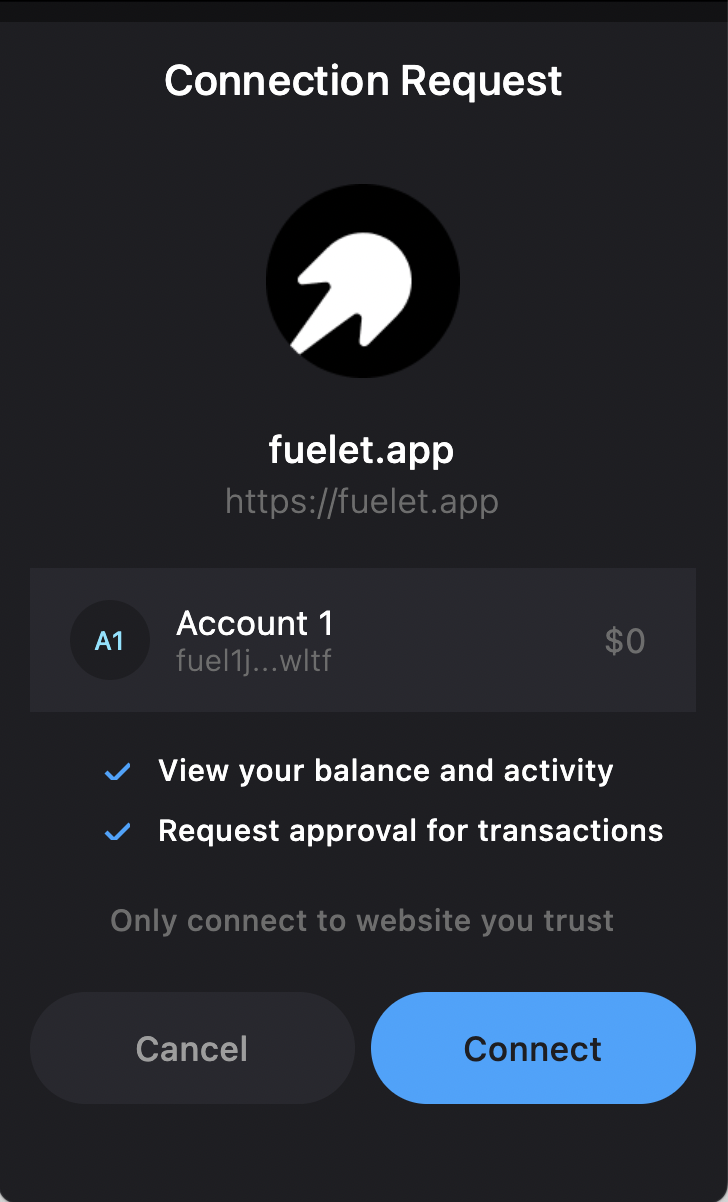
This method results in opening the wallet extension and prompts the user to connect to the website.
It returns `Promise` : it will be `true` if the user accepts the connection and `false` otherwise.
## Checking the connection status
To check if the user is already connected to the website, you can call the `isConnected()` method which also returns a `Promise`:
{% tabs %}
{% tab title="TypeScript" %}
```javascript
const isConnected = await fuel.isConnected();
console.log("Is connected response", isConnected);
```
{% endtab %}
{% endtabs %}